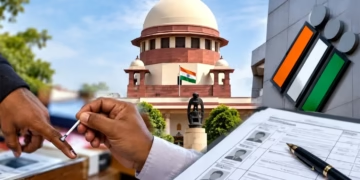
The Election Commission of India (ECI) has embarked on a transformative journey over the past 100 days, rolling out 21 impactful initiatives aimed at enhancing the electoral process and improving voter facilitation. Under the leadership of Chief Election Commissioner Shri Gyanesh Kumar, these measures reflect a commitment to streamline election management and elevate the overall voter experience.

During the Conference of Chief Electoral Officers (CEOs) held in March 2025, CEC Kumar unveiled a visionary plan for a more efficient ECI, with critical input from fellow Election Commissioners Dr. Sukhbir Singh Sandhu and Dr. Vivek Joshi. A focus on procedural reforms, stakeholder engagement, and comprehensive training programs has marked this significant phase in Indian electoral history.
One of the most significant changes includes the reduction of the maximum number of electors per polling station from 1,500 to 1,200. This adjustment aims to facilitate easier access for voters, ensuring no individual has to travel more than 2 kilometers to cast their vote. To further this objective, additional polling booths will be established in densely populated areas, including gated communities and high-rise buildings.
The ECI has also redesigned Voter Information Slips for improved clarity, ensuring that essential details such as serial and part numbers are prominently displayed. To enhance convenience, a Mobile Deposit Facility will be set up at every polling station’s entrance, streamlining the voting process.
In a move to simplify user interactions, the ECI has introduced the Integrated Dashboard, known as ECINET. This new platform consolidates various services for stakeholders into a single interface, replacing over 40 existing applications and websites. Some modules will be available for use in upcoming bye-polls, with a full rollout expected by the time of the Bihar Assembly elections.
Additionally, the ECI has initiated direct integration of death registration data from the Registrar General of India, allowing for timely updates to electoral rolls by removing deceased electors. Booth Level Officers (BLOs) will play a crucial role in ensuring the accuracy of these updates through field-level verification.
In an effort to foster regular interaction with political stakeholders, the ECI conducted 4,719 meetings across the country, engaging over 28,000 representatives from various political parties. Notable parties such as AAP, BJP, BSP, and CPI(M) participated in consultations aimed at addressing concerns and enhancing collaboration in the electoral process.
The ECI has also expanded training programs for Booth Level Officers (BLOs) and Supervisors, with over 3,500 individuals trained at the India International Institute of Democracy and Election Management (IIIDEM). The institute is set to train more than 100,000 BLO Supervisors in the coming years, ensuring a robust network of electoral facilitators.
In addition to training, the ECI has developed a comprehensive framework for 28 stakeholder categories involved in the electoral process. This includes training presentations based on relevant electoral laws and regulations, ensuring that all participants are well-versed in their roles and responsibilities.
Furthermore, the ECI convened a National Conference of Counsels to strengthen legal synergies and adapt the Commission’s legal framework to meet emerging challenges. This initiative brought together senior advocates from the Supreme Court and High Courts, along with officials from all states and union territories, to discuss strategies for enhancing electoral integrity.
As part of internal reforms, the ECI has implemented biometric attendance systems at its headquarters and activated the E-Office system, aiming to improve operational efficiency and coordination among its various divisions.
Through these 21 initiatives, the Election Commission of India is not only enhancing the electoral process but also fostering greater voter engagement and participation. As the country gears up for upcoming elections, these measures signify a pivotal step towards a more accessible and efficient electoral framework.