The Karbi Youth Festival located in Diphu—the central hub of the Karbi Anglong district, roughly 250 kilometers to the east of Guwahati—has withstood political turmoil and violent campaigns for autonomy to reach its 50th anniversary. However, its origins were anything but celebratory. The KYF’s 50th event, which will last for eight days, is set to commence on Friday. This edition will be notable for featuring President Droupadi Murmu, marking the first time a festival focused on a specific ethnic group in the Northeast has been graced by a president’s presence.

Over 20 years since its establishment in 1951, a campaign emerged in Karbi Anglong advocating for the adoption of the Roman alphabet for the Karbi language. The Karbi people lacked a written script, and with the arrival of missionaries during the period of British colonization, their language began to be written using both Assamese and Roman alphabets.
Chandra Sing Kro, who serves as the president of the Karbi Cultural Society (KCS), stated that the movement advocating for the use of the Roman script began in 1972 and gained significant momentum in the following year. However, when authorities suppressed the movement’s leaders, it prompted Roy Enghi and a contingent of intellectual young individuals to contemplate ways to safeguard the endangered cultural practices and heritage of the Karbi people.
 In 1974, the group initiated KYF, which has since developed into a unifying force for the Karbis in Karbi Anglong, other regions of Assam, and further afield. Concurrently with the Roman script campaign, there was a movement led by Karbi female students who chose to forgo their school uniforms. Instead, they attended classes in their indigenous clothing, leaving the school administration in a state of uncertainty and confusion.
Established in 1977, the KCS was created to collaborate with different communities, including tribal and non-tribal groups, to highlight and celebrate their cultural practices and heritage.
 The 50th anniversary celebration of the KYF is set to take place at the expansive 672-acre location known as the Karbi People’s Hall in Taralangso, situated on the periphery of Diphu. This venue not only serves as the festival’s fixed location but is also recognized as the biggest ethnic settlement in the Northeast. “Half a century back, we were on the brink of losing our cultural heritage, including our native clothing, folk music, dances, indigenous sports, and traditional food. The festival played a crucial role in preserving these elements,” stated Bidya Sing Rongpi, the chief secretary of the KCS.
 Beginning in the late 1980s, as ethnic-based radicalism took hold in Karbi Anglong, the KYF emerged as a means to promote unity within and between tribes. Over the last ten years, the region has seen a return to calm following the signing of peace agreements between the militant factions and the government.
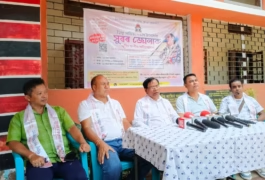
 Today’s sense of togetherness is highlighted by the collaboration between one-time adversaries, including past radicals and law enforcement officers, in the planning of the KYF. Moreover, it’s become quite common for representatives from the BJP—the party in power at the Karbi Anglong Autonomous Council (KAAC)—alongside those from the Congress, Marxist-Leninists, and various other political groups, to mingle and unite in support of cultural initiatives.
The KAAC, an important participant in the festival, holds the view that the KYF could achieve international recognition similar to the Hornbill Festival of Nagaland, which has been celebrated for twenty years. Richard Tokbi, an executive member of the KAAC and the general secretary of the festival’s reception committee, noted that the council has significantly increased funding to add an international dimension to the KYF, anticipating participation from numerous Southeast Asian delegates.
The KYF is set to showcase over 6,000 cultural acts across four stages, with around 2,000 booths being organized for attendees to enjoy local foods and purchase indigenous crafts. The event organizers are preparing for a daily attendance of 150,000 people.