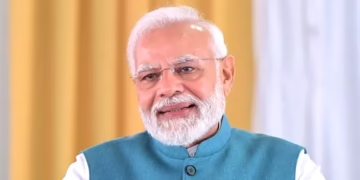
Prime Minister Narendra Modi celebrated his 75th birthday on Wednesday, September 17. His tenure as India’s leader for over a decade has been marked by groundbreaking policies that have significantly elevated the country’s trajectory. Under Modi’s leadership since 2014, various initiatives have reached deep into rural areas, creating new avenues for growth.

In the wake of his 75th birthday, it’s an opportune moment to reflect on some of the key policies and schemes introduced during his administration. One of his first significant actions after taking office was to simplify governance. Modi replaced the requirement for a government official to notarize documents for bureaucratic processes. Instead, he encouraged a system of self-attestation for documents such as certificates and marksheets. This change aimed to reduce the time and expense faced by citizens, especially students and job seekers, when interfacing with government services.
In 2015, the JAM (Jan Dhan-Aadhaar-Mobile) Trinity was introduced, revolutionizing the delivery of government benefits and promoting digital transformation. The Jan Dhan program ensured banking access for those previously excluded, while Aadhaar provided a unique identification system based on biometric data. The mobile component ensured effective communication for notifications and services, marking a significant step in reducing corruption and improving service delivery.
Modi’s government also created the Government e-Marketplace (GeM) within five months, facilitating online procurement for government agencies. GeM has significantly enhanced transparency and efficiency in public procurement, allowing for better vendor registration and opportunities for small and medium enterprises.
Another pivotal move was the demonetization policy enacted in 2016, which rendered ₹500 and ₹1,000 notes invalid. This bold decision targeted black money and corruption while promoting digital financial practices. The initiative successfully reintegrated a substantial amount of money into the formal banking system, expanding the tax base and encouraging the use of digital payment platforms across both urban and rural areas.
The introduction of the Goods and Services Tax (GST) in 2017 was transformative, streamlining the tax system by replacing multiple indirect taxes with a singular structure. More recently, the GST Council has proposed further reforms aimed at simplifying taxation even further.
Modi launched the Swachh Bharat Abhiyan, India’s largest cleanliness initiative, encouraging citizens to uphold the vision of a clean nation. By actively participating in this movement, he emphasized the importance of teamwork in achieving cleanliness, urging citizens to contribute to this national effort.
The establishment of Niti Aayog to replace the Planning Commission was another significant step. This policy-making body reflects the voices of Chief Ministers, economists, and the public, aiming to adapt to India’s evolving needs while drawing motivation from its constitutional framework.
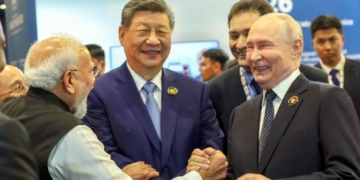
Under Modi’s guidance, India has also pivoted its foreign policy from the “Look East” to the “Act East” approach, strengthening ties with ASEAN nations through enhanced trade, cultural relationships, and security collaboration, counterbalancing China’s regional influence.
The Atmanirbhar Bharat initiative launched in May 2020 aimed to foster self-reliance in the Indian economy, comprising a substantial stimulus package to support various sectors. This initiative is anchored in the concepts of “Vocal for Local” and “Make in India,” promoting domestic manufacturing.
Furthermore, Modi’s Neighbourhood First policy emphasizes building robust relationships with neighboring countries through enhanced cooperation and cultural exchanges, aiming for mutual growth.
Finally, Modi has taken a strong stance on terrorism, particularly concerning threats from neighboring Pakistan. His administration has undertaken notable military operations aimed at curbing terrorism and he has declared that India will not tolerate nuclear blackmail, ensuring a steadfast message regarding national security.
Overall, these policies reflect Modi’s vision for India, covering economic, social, and security dimensions that aim to strengthen the country’s position domestically and globally.