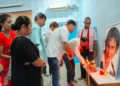
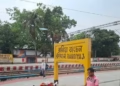
In a move that showcases commitment to educational reform and social inclusion, Assam’s Chief Minister, Dr. Himanta Biswa Sarma, recently conducted an engaging and insightful interaction with students of a madrassa in Kaziranga. This exchange signified more than a routine visit; it was a powerful gesture towards understanding and improving the educational framework within the Islamic schools of the region. Dr. Sarma’s initiative to directly communicate with the students provided him with a unique perspective on the workings of the madrassa system.

The Chief Minister’s visit to the Kuthuri Madrassa in Kaziranga became a platform for the students to voice their experiences and aspirations. The students of this particular madrassa were not just passive recipients of education but were given a voice to articulate their views on the academic environment they are a part of. Dr. Sarma’s approach to learning directly from the pupils about their needs and challenges is a commendable step towards educational inclusivity.
The madrassas are often seen as institutions focusing primarily on religious teachings. However, Dr. Sarma’s interaction with the students revealed a different story. The students discussed their academic curriculum, which is not limited to religious education but also includes modern subjects that are crucial for holistic development. This eye-opening conversation highlighted the need for a broader public understanding of the role that madrassas play in shaping young minds.
 The Chief Minister listened intently to the students, who shared their experiences and the challenges they encounter within the educational system. They spoke about the importance of integrating modern education with traditional teachings, which would enable them to compete on equal footing with their peers from other educational backgrounds. Dr. Sarma acknowledged the significance of their concerns and the need for a balanced curriculum that would empower the students intellectually and spiritually.
The significance of Dr. Sarma’s visit lies in the potential policy implications that may arise from such interactions. By engaging with the students and understanding their perspective, the Chief Minister has taken a proactive step towards formulating policies that could transform the madrassa education system. This could lead to a more inclusive and diverse educational landscape in Assam, where students from all backgrounds have access to quality education that prepares them for the future.
The Chief Minister’s dialogue with the students is not just about academic reforms; it is also about societal transformation. By empowering these students through education, there is an opportunity to bridge communities and foster a spirit of unity and understanding. Dr. Sarma’s initiative in Kaziranga can be seen as a blueprint for other regions to follow, showcasing how government and educational institutions can work together for the betterment of society.
The conversation between Dr. Sarma and the madrassa students is a testament to the evolving nature of Islamic education in Assam. It underscores the importance of preserving religious traditions while simultaneously embracing modernity. The Chief Minister’s visit sends a clear message that progress does not have to come at the expense of cultural and religious heritage.
The students’ eagerness to learn and adapt to a rapidly changing world was evident during the interaction. They expressed a desire to pursue higher education and contribute to the development of their state and country. Dr. Sarma reassured them that the government is committed to providing them with the necessary support and resources to achieve their goals.
Assam’s Chief Minister, through his constructive engagement, has laid the groundwork for a future where madrassa students are not just participants but drivers of innovation and excellence. The state’s investment in their education is an investment in a progressive and dynamic future for Assam.
The visit by Dr. Sarma to the Kuthuri Madrassa is a remarkable example of leadership that listens, understands, and acts. It signifies a hopeful future for the students and for the educational system as a whole. As Assam continues on its path of development, it is essential that every child, irrespective of their background, is given the opportunity to learn, grow, and succeed.
The Chief Minister’s dialogue with madrassa students in Kaziranga is a powerful affirmation of the government’s dedication to educational empowerment and social harmony. It is a significant step towards building an Assam that values knowledge, respects diversity, and nurtures talent across all communities.
In conclusion, Dr. Himanta Biswa Sarma’s visit to the Kuthuri Madrassa may well be the catalyst for a new era of educational excellence in Assam. By bringing the voices of madrassa students to the forefront, he has initiated a dialogue that could redefine the future of Islamic education in the state and beyond.